What Happens to Electrons in an Ionic Bond
Ionic Bonding and Electron Transfer
An ionic bail results from the transfer of an electron from a metallic atom to a non-metal atom.
Learning Objectives
Place the key features of ionic bonds
Key Takeaways
Primal Points
- Ionic bonds are formed between cations and anions.
- A cation is formed when a metal ion loses a valence electron while an anion is formed when a not-metal gains a valence electron. They both achieve a more stable electronic configuration through this exchange.
- Ionic solids course crystalline lattices, or repeating patterns of atoms, with high melting points, and are typically soluble in water.
Fundamental Terms
- electrolyte: An ionic compound which dissolves in H2O, making the resulting solution capable of conducting electricity.
- electronegativity: The tendency of an atom to attract electrons to itself.
- cation: A positively charged ion.
- anion: A negatively charged ion.
Ionic Bonds
Ionic bonding is a type of chemical bond in which valence electrons are lost from one atom and gained by some other. This substitution results in a more stable, noble gas electronic configuration for both atoms involved. An ionic bond is based on attractive electrostatic forces between ii ions of opposite charge.
Cations and Anions
Ionic bonds involve a cation and an anion. The bond is formed when an atom, typically a metal, loses an electron or electrons, and becomes a positive ion, or cation. Another atom, typically a non-metal, is able to larn the electron(s) to become a negative ion, or anion.
One example of an ionic bond is the formation of sodium fluoride, NaF, from a sodium atom and a fluorine atom. In this reaction, the sodium atom loses its single valence electron to the fluorine atom, which has just plenty infinite to have it. The ions produced are oppositely charged and are attracted to one some other due to electrostatic forces.
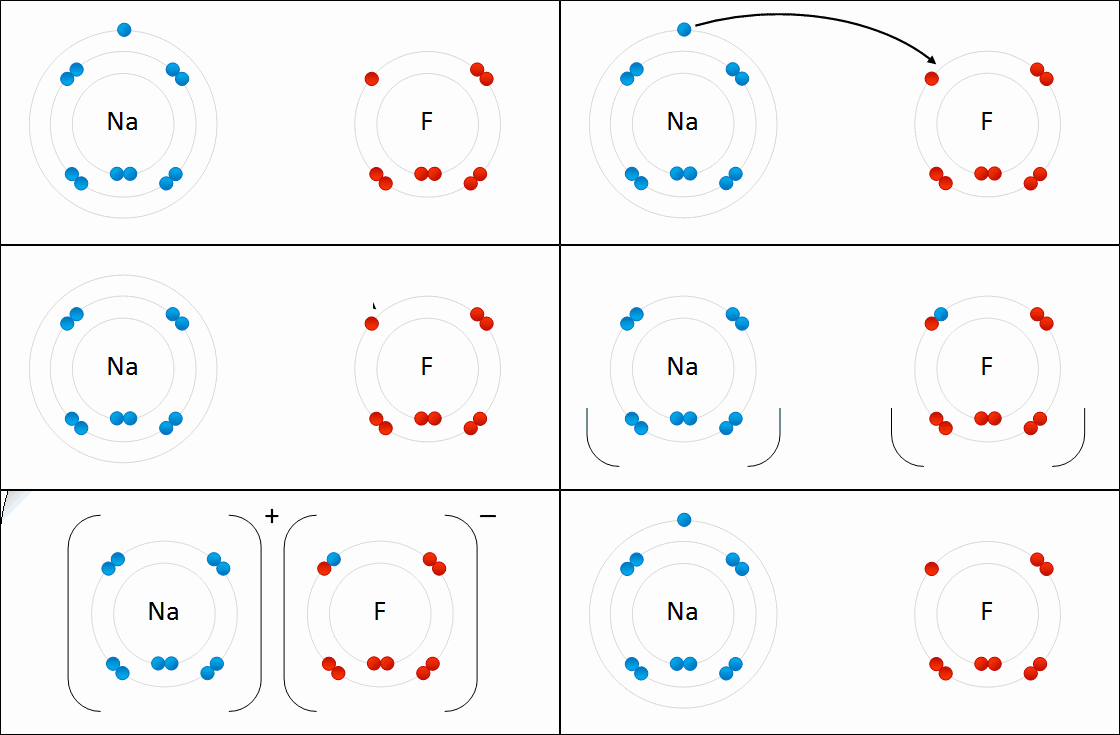
Formation of NaF: An electron is transferred from Na to F. The resulting Na+ and F– ions are electrically attracted to each other.
At the macroscopic scale, ionic compounds form lattices, are crystalline solids under normal conditions, and have high melting points. Well-nigh of these solids are soluble in HtwoO and behave electricity when dissolved. The ability to conduct electricity in solution is why these substances are called electrolytes. Table salt, NaCl, is a good example of this type of compound.
Ionic bonds differ from covalent bonds. Both types result in the stable electronic states associated with the noble gases. However, in covalent bonds, the electrons are shared between the two atoms. All ionic bonds have some covalent character, but the larger the difference in electronegativity between the two atoms, the greater the ionic character of the interaction.
Lattice Energy
Lattice energy is a mensurate of the bond strength in an ionic compound.
Learning Objectives
Describe lattice energy and the factors that bear upon it
Key Takeaways
Key Points
- Lattice energy is defined as the free energy required to separate a mole of an ionic solid into gaseous ions.
- Lattice energy cannot be measured empirically, but it can be calculated using electrostatics or estimated using the Born-Haber bike.
- Two main factors that contribute to the magnitude of the lattice energy are the charge and radius of the bonded ions.
Primal Terms
- exothermic reaction: A process which releases oestrus into its environs.
- lattice free energy: The corporeality of energy released upon germination of a crystalline ionic solid from gaseous ions.
Definition of Lattice Energy
Lattice energy is an gauge of the bail strength in ionic compounds. Information technology is defined as the heat of formation for ions of reverse charge in the gas phase to combine into an ionic solid. As an example, the lattice energy of sodium chloride, NaCl, is the energy released when gaseous Na+ and Cl– ions come together to course a lattice of alternating ions in the NaCl crystal.
[latex]\text{Na}^+ (grand) + \text{Cl}^- (yard) \rightarrow \text{NaCl} (s) \;\;\;\;\;\;\;\;\;\;\;\;\;\;\; \Delta H=-787.3\text{ kJ/mol}[/latex]
The negative sign of the free energy is indicative of an exothermic reaction.
Alternatively, lattice energy can be idea of as the energy required to separate a mole of an ionic solid into the gaseous class of its ions (that is, the reverse of the reaction shown above).
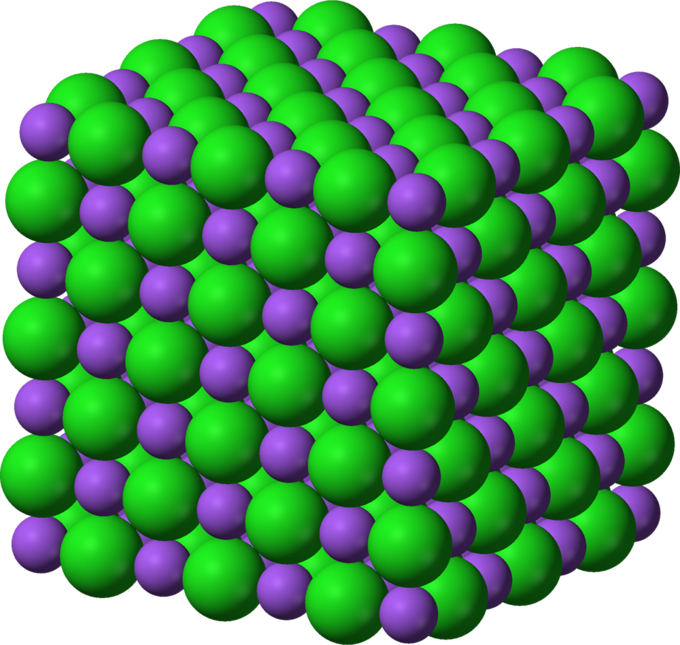
NaCl Crystalline Lattice: Sodium ions (Na+) and chloride(Cl–) ions, depicted in purple and green respectively, alternate in the crystal lattice of solid NaCl.
Alternatively, lattice energy tin can be idea of as the energy required to split a mole of an ionic solid into the gaseous form of its ions (that is, the reverse of the reaction shown above).
Lattice energy cannot exist determined experimentally due to the difficulty in isolating gaseous ions. The energy value can be estimated using the Born-Haber cycle, or information technology tin be calculated theoretically with an electrostatic examination of the crystal structure.
Factors Affecting Lattice Free energy
In 1918, Born and Lande presented the following model for lattice free energy:
[latex]Eastward = - \frac {N_AMz^+z^-e^2}{4 \pi \epsilon_o r_o} (ane-\frac {one}{n})[/latex]
In this equation, Due northA is Avogadro's constant; M is the Madelung constant, which depends on the crystal geometry; z+ is the charge number of the cation; z– is the charge number of the anion; e is the uncomplicated charge of the electron; northward is the Born exponent, a feature of the compressibility of the solid; [latex]\epsilon _o[/latex] is the permittivity of gratis space; and r0 is the distance to the closest ion.
This model emphasizes two primary factors that contribute to the lattice energy of an ionic solid: the charge on the ions, and the radius, or size, of the ions. The effect of those factors is:
- as the charge of the ions increases, the lattice energy increases
- as the size of the ions increases, the lattice energy decreases
Lattice energies are also important in predicting the solubility of ionic solids in HtwoO. Ionic compounds with smaller lattice energies tend to be more soluble in H2O.
Formulas of Ionic Compounds
Ionic formulas must satisfy the noble gas configurations for the elective ions and the product compound must be electrically neutral.
Learning Objectives
Use knowledge of ionic bonding to predict the formula of ionic compounds
Key Takeaways
Key Points
- The charge on the cations and anions in an ionic compound can be adamant by the loss or gain of valence electrons necessary in gild to achieve stable, noble gas electronic configurations.
- The number of cations and anions that are combined in an ionic compound is the simplest ratio of whole integers that tin be combined to reach electrical neutrality.
- The cation precedes the anion in both the written form and the formula.
Key Terms
- noble gas: Whatever of the elements of grouping 18 of the periodic table, which are monatomic and, with very express exceptions, inert, or non-reactive.
- electrically neutral: A net charge of zero, which occurs when an atom or molecule/compound has no surplus or deficit of electrons.
- empirical formula: The simplest whole-number ratio betwixt elements in a formula of a compound.
- polyatomic ion: An ion composed of several atoms.
Ionic Compounds
An ionic bond is formed through the transfer of ane or more valence electrons, typically from a metal to a non-metal, which produces a cation and an anion that are bound together by an bonny electrostatic force. On a macroscopic scale, ionic compounds, such as sodium chloride (NaCl), grade a crystalline lattice and are solids at normal temperatures and pressures.
Crystalline Lattice: Sodium chloride crystal lattice
The charge on the cations and anions is determined past the number of electrons required to accomplish stable noble gas electronic configurations. The ionic composition is and then divers by the requirement that the resulting chemical compound be electrically neutral overall.
For instance, to combine magnesium (Mg) and bromine (Br) to become an ionic compound, we start note the electronic configurations of these atoms (valence level in indicated in italics):
Mg: 1s22s22p6 3s2
Br: 1s22s22p63s23p63d10 4s24p5
In guild to achieve noble gas configurations, the magnesium cantlet needs to lose its two valence electrons, while the bromine atom, which has 7 valence electrons, requires ane additional electron to fill up its outer beat out. Therefore, for the resulting compound to be neutral, two bromine anions must combine with i magnesium cation to form magnesium bromide (MgBr2). In addition, though whatsoever ratio of two bromine atoms to 1 magnesium cantlet will satisfy the two requirements above, the formula for ionic compounds is typically presented as the empirical formula, or the simplest whole-number ratio of atoms with positive integers.
Note that the cation e'er precedes the anion both in written course and in formulas. In the written course, while the cation name is generally the same as the element, the suffix of single-cantlet anions is changed to –ide, as in the case of sodium chloride. If the anion is a polyatomic ion, its suffix tin can vary, only is typically either –ate or –ite,as in the cases of sodium phosphate and calcium nitrite, depending on the identity of the ion.
More examples:
- lithium fluoride: Li+ and F– combine to grade LiF
- calcium chloride: Ca2+ and Cl– combine to form CaCl2
- iron (II) oxide: Atomic number 262+ and O2- combine to form FeO
- aluminum sulfide: Al3+ and S2- combine to form Al2Due south3
- sodium sulfate: Na+ and And then4 2- combine to class Na2Then4
- ammonium phosphate: NH4+ and PO4 3- combine to form (NH4)3PO4
- potassium chlorite: One thousand+ and ClO2 – combine to course KClOtwo
Video Summary
Ionic vs Covalent Bail Graphic symbol
Ionic bonds can accept some covalent character.
Learning Objectives
Hash out the idea that, in nature, bonds exhibit characteristics of both ionic and covalent bonds
Key Takeaways
Key Points
- Ionic bonding is presented as the consummate transfer of valence electrons, typically from a metallic to a not-metal.
- In reality, electron density remains shared between the constituent atoms, meaning all bonds have some covalent character.
- The ionic or covalent nature of a bond is determined by the relative electronegativities of the atoms involved.
Key Terms
- polar covalent bond: A covalent bond that has a partial ionic character to it, equally a result of the difference in electronegativity between the two bonding atoms.
- electronegativity: A measure of the tendency of an atom to concenter electrons to itself.
- covalent character: The fractional sharing of electrons between atoms that have an ionic bail.
Ionic vs Covalent Bonding
Chemical compounds are frequently classified by the bonds between elective atoms. There are multiple kinds of bonny forces, including covalent, ionic, and metal bonds. Ionic bonding models are generally presented every bit the consummate loss or proceeds of one or more valence electrons from a metallic to a nonmetal, resulting in cations and anions that are held together by attractive electrostatic forces.
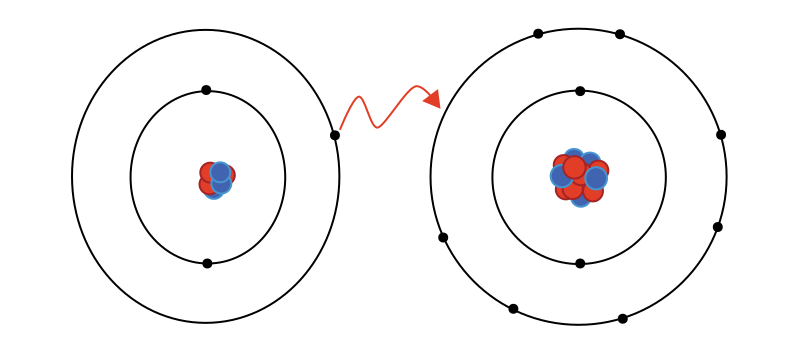
Ionic bonding: The formation of an ionic bail between lithium and fluorine to form LiF.

Example of a polar covalent bond: When a carbon atom forms a bond with fluorine, they share a pair of electrons. Still, considering fluorine is more highly electronegative than carbon, information technology attracts that shared electron pair closer to itself and thus creates an electric dipole. The lowercase greek delta written to a higher place the atoms is used to indicate the presence of fractional charges. This bond is considered to have characteristics of both covalent and ionic bonds.
In reality, the bond between these atoms is more than complex than this model illustrates. The bond formed between whatsoever two atoms is not a purely ionic bail. All bonding interactions take some covalent character because the electron density remains shared between the atoms. The degree of ionic versus covalent character of a bail is determined past the difference in electronegativity between the constituent atoms. The larger the difference, the more than ionic the nature of the bond. In the conventional presentation, bonds are designated as ionic when the ionic aspect is greater than the covalent aspect of the bond. Bonds that fall in betwixt the ii extremes, having both ionic and covalent character, are classified equally polar covalent bonds. Such bonds are thought of equally consisting of partially charged positive and negative poles.
Though ionic and covalent character correspond points along a continuum, these designations are oft useful in understanding and comparing the macroscopic properties of ionic and covalent compounds. For example, ionic compounds typically have higher boiling and melting points, and they are also normally more than soluble in water than covalent compounds.
Source: https://courses.lumenlearning.com/trident-boundless-chemistry/chapter/the-ionic-bond/

Postar um comentário for "What Happens to Electrons in an Ionic Bond"